
Sigmund Lee
Ward 2 Resident | Candidate for Richmond Hill Council
Practical leadership you can trust.
Blog Updates
Campaign joys, campaign pains and everything in between, one doorstep at a time.
This is where I share the moments behind the campaign: conversations with residents, observations from Ward 2, community news, public service information, campaign milestones and the occasional bit of humour.
Public Commentary explains my positions on major issues. Blog Updates shows the work, the conversations and the people behind those positions.
Start Here
Select any title below to read the full update. New entries will be added as the campaign continues.
For my views on taxes, accountability, growth, safety and other municipal issues, visit my
Public Commentary page.
This and That: Trees, Snow, City Services and Conversations in Ward 2 – October 13, 2026
I hope everyone enjoyed a pleasant Thanksgiving long weekend with family and friends.
As I continue walking through Ward 2 and speaking with residents, I hear about many issues that may not attract much public attention but have a real impact on people’s everyday lives.
Some concerns are about costs. Others are about how City services are delivered. And sometimes, the question is simply whether an existing policy still makes sense.
Here are a few things I’ve been thinking about.
1. Tree Removal: Are the Rules Too Complicated for Homeowners?
Richmond Hill has rules to protect trees on private property. I understand the importance of preserving our tree canopy.
I also understand why developers undertaking major construction projects must provide arborist reports, tree preservation plans, and replacement trees.
But what about an ordinary homeowner who has one problematic tree on their property?
Perhaps the roots are damaging a driveway, the tree is affecting nearby structures, or there are legitimate concerns about its condition.
Under the City’s standard tree-removal process, a homeowner may need to hire a qualified arborist to prepare a report before applying for a permit. That is an expense before the City even decides whether the tree can be removed.
Then there is the permit fee, the cost of hiring a professional tree-removal contractor, and potentially the requirement to plant replacement trees.
For example, under the City’s published 2026 fee schedule, a standard permit for the first regulated tree costs $314 plus HST. Depending on the tree’s size, removing one tree may require several replacement trees.
For a tree measuring 41–50 cm in trunk diameter, the replacement requirement is three trees. Where cash-in-lieu is permitted, the published amount is $945 per replacement tree.
That means $2,835 for three replacement trees alone.
Add the permit, arborist report, and actual tree-removal costs, and a homeowner could potentially face a bill exceeding $5,000.
I recognize that different provisions apply to certain dead, dying, or hazardous trees, and not every tree-removal application faces identical requirements.
But I have a few questions.
Why can’t qualified City staff visit the property, inspect the tree, and determine whether removal should be permitted?
Why must a homeowner hire a third-party professional for a standard application when City staff already have responsibilities for administering the Tree Preservation By-law?
Could the City provide an initial inspection and require a detailed independent report only where the circumstances warrant one?
And if a homeowner has a small residential lot, where exactly are three replacement trees supposed to go?
I understand that developers and large construction projects require careful environmental oversight. But removing one problematic tree from an established residential property is a different situation.
Shouldn’t the process reflect that difference?
Protecting our tree canopy is important. So is making sure our policies are practical, proportionate, and affordable for residents.
2. Windrow Clearing: Does the Service Meet Residents’ Needs?
Another issue raised during my conversations concerns the City’s windrow-clearing program.
A windrow is the pile of snow left across a driveway entrance after a snowplow clears the road.
Richmond Hill provides a residential windrow-clearing service, but the City advises that clearing may take up to 13 hours after snowfall ends.
For many residents, especially those who need to leave early for work, waiting that long simply isn’t practical.
They often end up clearing enough snow themselves to get their vehicles out.
Some residents have also raised questions about what happens if they have already cleared part of their driveway entrance.
Will the City still clear the remaining windrow, or will the driveway be skipped?
I have not verified that partially clearing a driveway affects eligibility for the service. This is something I believe the City should clarify.
But there is a larger issue.
How much does the windrow-clearing program cost taxpayers each year?
How many residents receive the service before they need to leave home?
And are there more effective ways to provide assistance?
I recognize that windrow clearing can be particularly valuable for seniors, residents with disabilities, and others who may have difficulty clearing heavy snow.
Perhaps we should examine whether a more targeted or differently structured service could better meet residents’ needs.
I’m not suggesting that the program should simply be eliminated. I am suggesting that we should examine its costs, timing, and effectiveness.
Easier Said Than Done
Some residents have suggested discontinuing the windrow-clearing program and selling the equipment. I understand why, particularly when people have already had to clear their driveway entrances themselves.
But ending a municipal service is not necessarily as simple as selling equipment and declaring the savings.
We first need to know how the program is staffed, which vehicles and equipment are dedicated to it, and whether those resources are also used for other municipal work.
If permanent employees are involved, what happens to their positions? Could they be reassigned to other necessary services? Would that reduce spending, or would the same payroll costs simply appear elsewhere in the City’s operations?
Likewise, selling equipment only makes sense if the City no longer needs it for other duties. We also need to account for any contractual obligations and the cost of providing alternative assistance to residents who rely on the service.
There is another important consideration. If the City eventually decides to discontinue the general windrow-clearing program, I believe we should examine bringing back a free or low-cost snow-clearing assistance service for seniors and residents who are physically unable to clear their own driveway entrances.
Such a service could be based on demonstrated need, with free assistance for eligible residents and affordable fees where appropriate. We would need to examine how it could be delivered, what it would cost, and whether it could operate more effectively than the current approach.
Reducing municipal spending should not mean abandoning residents who genuinely need help. The goal should be to provide the right service to the right people, at a cost taxpayers can reasonably support.
There may be opportunities to improve the program, redesign it, provide more targeted assistance, or phase in changes. But those options need to be evaluated against actual costs and service outcomes.
It’s easy to say, “Just get rid of it.” The harder part is finding a practical solution that delivers genuine savings without creating bigger problems elsewhere.
Providing a service is one thing. Making sure it delivers value to residents is another.
3. Preventive Maintenance: Sometimes the Little Things Matter
With autumn upon us and winter approaching, another practical concern comes to mind.
Every fall, leaves accumulate along roads and curbs. When heavy rain arrives, those leaves can collect around catch basins and block stormwater drainage.
The result can be water pooling on streets, creating inconvenience and potentially contributing to localized flooding.
During winter, snow, ice, and debris can cause similar problems, particularly when temperatures rise and snow begins to melt.
My question is simple:
Are we doing enough preventive maintenance before these problems occur?
Do we have an effective schedule for clearing leaves and debris from roads and catch basins before the winter season?
Are locations with recurring drainage problems identified and given priority before major storms?
Could better coordination between street sweeping, drainage maintenance, and weather forecasts help reduce avoidable problems?
Of course, no maintenance program can prevent every flooding incident, particularly during extreme weather.
But preventive maintenance is an important part of responsible municipal management.
Sometimes, improving City services doesn’t require a new program or a larger budget. It may simply require reviewing how existing resources are scheduled and deployed.
A little prevention at the right time can sometimes avoid a much bigger problem later.
4. A Pleasant Surprise While Knocking on Doors
On a lighter note, I want to share something that happened during my walks around Ward 2.
I met several residents who had attended the Richmond Hill Board of Trade (RHBOT) candidates’ meeting.
They told me they liked some of the answers I gave during the meeting.
But what I found particularly encouraging was that they were genuinely happy to see me at their doors, even though they had already met me at the candidates’ meeting.
I thought that was rather nice.
A candidates’ meeting allows residents to hear what candidates have to say. But visiting someone at their home offers a different opportunity.
It allows for a more personal conversation, where residents can ask questions, share concerns, and speak about issues that matter to them.
Not every conversation is about politics. Sometimes we simply talk about the neighbourhood, the weather, or everyday life.
And I enjoy those conversations.
I am grateful to everyone who has taken a few minutes to speak with me, whether we agree on everything or not.
5. What Would I Do?
If elected to Council, I would bring these questions forward and seek clear answers.
On tree removal, I would ask for a review of the permit process, arborist-report requirements, fees, and replacement-tree rules for existing residential properties. I would particularly like to examine whether qualified City staff could conduct initial inspections, reducing the need for homeowners to hire third-party professionals in straightforward cases.
On windrow clearing, I would request information about the program’s annual cost, operating procedures, and service performance. I would also seek clarification on whether residents who have already cleared part of their driveway entrance are still entitled to the service. I would examine staffing arrangements, equipment utilization, contractual commitments, and which costs could actually be avoided under different options. If discontinuing the general program proves practical and financially worthwhile, I would explore restoring free or low-cost assistance for eligible seniors and residents who are physically unable to clear their own snow. Any proposed change should protect those who genuinely need help while delivering measurable value to taxpayers.
On preventive maintenance, I would examine how the City schedules street sweeping and catch-basin cleaning, particularly before major storms and winter weather. I would want to understand whether recurring problem areas are identified and whether existing resources could be deployed more effectively.
I am not suggesting that I already have all the answers.
But I believe residents deserve to know that their concerns will be examined, that questions will be asked, and that decisions will be based on facts, costs, and practical results.
That is the approach I would bring to Council.
6. A Final Thought
With Thanksgiving behind us, we are now entering the final week before online voting begins on October 20, followed by Election Day on October 26.
Over the past several months, this campaign has given me the opportunity to meet many residents, hear different perspectives, and learn more about the everyday concerns of Ward 2.
The experience has reinforced something I have always believed:
Good government begins with listening, asking questions, understanding the facts, and being willing to examine whether existing practices still make sense.
We don’t always need grand announcements or complicated new initiatives.
Sometimes, what residents want is quite simple: reasonable rules, reliable services, responsible spending, and a City that listens.
Regardless of the election outcome, I am grateful for the conversations, experiences, and friendships this campaign has brought me.
To everyone who has welcomed me at their door, shared a concern, asked a question, or offered a word of encouragement, thank you.
The conversations continue, and so does my work throughout Ward 2.
Sigmund Lee, CPA, FCA (Ireland)
Candidate for Richmond Hill Council, Ward 2
A Good Evening of Conversation, Questions and Community – October 8, 2026
Last evening, I attended the Richmond Hill Board of Trade’s 2026 Municipal All Candidates Event. It was a great evening, and I want to thank everyone who helped make it happen.
Thank you to the Richmond Hill Board of Trade (RHBOT) for hosting the event, the panelists and moderators for guiding the discussion, the volunteers who helped everything run smoothly, my fellow candidates who participated, and especially the residents who took the time to attend.
It was also a wonderful opportunity to reconnect with people I had not seen for quite some time.
I met others for the first time in person, although some already knew me through my postings on Nextdoor and Facebook. It was interesting to discover that people I had never met were already familiar with my views and commentary.
Sometimes we post something online without knowing who is reading. Last evening was a pleasant reminder that those conversations can extend well beyond the screen.
Forty Seconds to Make Your Point
The format was particularly interesting.
There were eight questions from the panel, with approximately 40 seconds allowed for each answer. Questions from the audience were given even shorter response times, around 30 seconds.
I actually liked that arrangement.
Forty seconds is just about enough time to make a clear point, but not enough time to wander away from the question.
You have to listen carefully, identify what is being asked and get directly to your answer.
There is little room for lengthy introductions, political speeches or explanations that never quite reach a conclusion.
In a way, that is a useful discipline for anyone seeking public office.
Residents deserve clear answers. If a candidate cannot explain a position briefly, perhaps the candidate needs to think more carefully about what the position actually is.
Of course, some municipal issues are complicated and cannot be fully explained in 40 seconds. But a short answer should still demonstrate that the candidate understands the issue and knows which questions need further examination.
Familiar Questions, Familiar Concerns
Many of the topics raised during the evening were familiar to me.
Over the past several months, I have written extensively on my website about municipal finances, property taxes, accountability, development, neighbourhood concerns, public services and how City Hall should operate.
I have also discussed many of these matters with residents while going door to door across Ward 2.
That preparation was useful. I was not hearing many of these issues for the first time.
My Public Commentary page contains more detailed explanations of my positions, the reasoning behind them and, where appropriate, supporting information.
Forty seconds may be enough to summarize an answer. It is not enough to explain every consideration behind it.
That is one reason I maintain my website as a continuing public record. Residents who want more than a short campaign answer can read the fuller discussion and decide for themselves.
An Important Question: What Can the City Actually Do?
One observation stood out to me during the audience questions.
Several questions touched on matters where Richmond Hill has limited direct authority or where the primary responsibility belongs to another level of government.
That is understandable.
Residents experience problems in their daily lives. They do not necessarily divide those problems into municipal, regional, provincial or federal responsibilities before asking for help.
Nor should they have to become experts in government jurisdiction simply to raise a concern.
But candidates and councillors need to understand those distinctions.
Some services are delivered directly by Richmond Hill. Others fall under York Region, the Province or the federal government. Some responsibilities overlap and require cooperation.
A councillor should be able to explain what the City can do, what requires cooperation with another government and what is beyond the City’s authority.
A problem can be important to Richmond Hill residents without Richmond Hill having the power to solve it on its own.
That does not mean dismissing the question.
It means giving residents an accurate answer rather than making a promise that cannot realistically be delivered.
Sometimes the appropriate response is direct municipal action. Sometimes it is coordination, advocacy or helping residents reach the organization responsible.
I recently discussed this very issue in my October 5 Public Commentary, Stay in Our Lane: Focusing City Hall Where It Can Make a Difference.
The point is not that City Hall should ignore issues outside its direct jurisdiction. It is that Council should be honest about what it can accomplish, distinguish advocacy from action, and focus municipal time and resources where they can produce meaningful results.
My approach comes down to three questions:
- Does Richmond Hill have meaningful authority or responsibility?
- What practical and measurable result can the City produce?
- Is the effort proportionate to the result, and does it justify the resources?
These are questions I believe Council should ask before committing public money, staff time or municipal resources.
What an All Candidates Meeting Can Tell Us
An event like this gives residents something that campaign signs and flyers cannot always provide.
It allows them to see candidates in the same room, hear their responses to similar questions and observe how they communicate under time constraints.
No one can explain an entire municipal platform in a few short answers, and one evening cannot reveal everything about a candidate’s knowledge, judgment or experience.
But it gives residents another opportunity to compare approaches and decide what matters to them.
For me, the evening was also a reminder that listening is just as important as answering.
The questions residents ask tell us what is on their minds, including concerns that may not fit neatly within municipal responsibilities.
Those concerns still deserve to be heard and taken seriously.
Thank You for a Great Evening
I enjoyed the event, the conversations before and after the formal questions, and the opportunity to reconnect with familiar faces while meeting new people.
My thanks again to RHBOT, the panelists, moderators, volunteers, participating candidates and everyone who attended.
Organizing an event like this takes considerable effort, and I appreciate the opportunity it provided for residents to hear directly from candidates.
Whatever our different views or approaches, participating in a respectful public discussion is an important part of the democratic process.
The election will determine who serves on Council. But evenings like this remind me that local democracy is also about residents asking questions, candidates explaining their positions and everyone having an opportunity to listen.
And yes, I still think 40 seconds was just about perfect. LOL.
Sigmund Lee, CPA, FCA (Ireland)
Candidate for Richmond Hill Council, Ward 2
Related reading:
Stay in Our Lane: Focusing City Hall Where It Can Make a Difference (October 5, 2026)
Listening at the Door: Food, Language and Community – October 4, 2026
Sometimes a campaign conversation begins with taxes, traffic or development. Sometimes it begins with Malaysian food.
Today, while going door to door, I met a resident who was working outside his garage.
I did not want to interrupt what he was doing, so I told him he could continue working and that I would simply leave my flyer at the door. He could check me out later if he wished.
He looked at me and said nothing.
I wished him a good afternoon and started walking away.
Then he asked me, “Do you speak Chinese?”
I said yes, although not perfectly.
That changed the whole conversation.
He switched to Chinese and asked whether I liked Malaysian food. I told him I love Malaysian food. Then came the serious question: which place has the best food?
I mentioned one local place I like for laksa and nasi lemak. We then talked about Malaysian desserts, places in Scarborough, and another restaurant in Toronto that he insisted I must try if I want the best Malaysian food in the GTA.
I told him I had heard of it, but because it is downtown, I had not gone.
He made it very clear that this was not a good enough excuse.
Door knocking is not just about handing out flyers. It is about meeting people where they are.
A Conversation, Not a Script
By the end of the conversation, he told me that I had the four votes in his family.
I laughed afterward because it was a reminder that campaigning can take unexpected turns. You prepare to talk about taxes, services, infrastructure and accountability, and then a conversation about laksa and nasi lemak becomes the moment that opens the door.
But there is a lesson in that.
Residents are not just voters. They are neighbours, families, stories, languages, cultures and lived experiences. Sometimes the best conversations happen only after you stop trying to deliver a message and simply listen.
What Door Knocking Teaches
Going door to door has reminded me that every resident has a different way of deciding who they trust.
Some residents want to talk about taxes. Some want to talk about traffic, safety, development, recreation or City services. Some want to know whether a candidate has done the homework. Some want to know whether the candidate will follow up after the election.
And sometimes, people want to know whether you understand their community well enough to have a real conversation.
That is why I value these encounters. They are not staged. They are not scripted. They are real moments with real residents.
They remind me that representation is not only about speaking at Council. It begins with listening at the door.
And sometimes, it begins with a good conversation about food.
Sigmund Lee
Candidate for Richmond Hill Council, Ward 2
Listening at the Door: Pickleball, Recreation and Fiscal Responsibility – September 29, 2026
Over the past several weeks, I have had more than 50 conversations at the door about pickleball courts and recreation space in Richmond Hill.
Taxes, safety, traffic and development remain some of the major issues residents raise with me. But pickleball has clearly become one of the recurring local topics in Ward 2.
I have also seen the demand myself. I go to the McConaghy Centre about twice a month, and the gym is being used. There are often 10 to 20 people waiting outside. That tells me this is not just a casual request. There is real interest, real participation and real pressure on available space.
I support working with the people involved in pickleball to find practical solutions. The goal should be to make it work for both the City and the sport.
Fiscal responsibility does not mean saying no to every request. It means asking the right questions before saying yes.
A Practical Approach
If there is growing demand for pickleball, Council should not ignore it. But Council also should not make promises without understanding the cost, location and impact.
The City should look at practical options first:
- Can existing City facilities be used more efficiently?
- Can time slots be adjusted to better reflect demand?
- Can underused courts or spaces be converted or shared?
- Are there outdoor locations that make sense?
- Can school gyms be used through permits or partnerships?
- Are there noise, parking, lighting, accessibility or neighbourhood impacts?
- Can quieter balls, equipment standards, acoustic or wind barriers, fencing, screens, landscaping or location choices help reduce noise and weather impacts?
- What are the capital costs and future maintenance costs?
- Are grants, sponsorships, development charges, user fees or other funding sources available?
These questions do not weaken support for pickleball. They make the support more serious.
Noise and Weather Have to Be Part of the Solution
Two practical concerns that have to be addressed honestly are noise and weather.
Pickleball has a distinct sound, and outdoor courts located too close to homes can create real concerns for nearby residents. At the same time, pickleball uses a light ball, so wind can affect play, especially in exposed outdoor locations.
That does not mean the City should avoid the issue. It means the City should plan properly.
Possible solutions could include choosing locations carefully, setting reasonable hours, considering indoor or school-gym options, reviewing quieter balls or equipment, and examining sound-reduction or wind-reduction measures such as fencing, acoustic panels, screens, landscaping or other barriers where appropriate.
Those options have costs. Some may be affordable. Others may not be practical in every location. That is why the City should work with pickleball players, nearby residents, staff and community partners before deciding where courts should go and how they should operate.
A good solution should support the sport without creating unnecessary conflict with surrounding neighbourhoods or building courts that do not work well for players.
Supporting Recreation Responsibly
Recreation matters. It helps residents stay active, builds community and makes better use of public spaces. When many residents raise the same issue again and again, Council should listen.
At the same time, every project has to fit into the broader financial picture. Richmond Hill is already facing pressure on taxes, infrastructure, facilities and services. A good idea still needs a funding plan.
That means bringing the issue into the capital planning process, working with users and community groups, reviewing practical locations, examining partnerships and reporting back with real numbers.
Pickleball may sound like a small issue compared with taxes, crime, traffic and development. But it is also a good example of how I believe local government should work: listen to residents, look at what is already happening, work with the people directly involved, understand the cost and find practical options.
That is how we make better use of public facilities.
That is how we support recreation without forgetting taxpayers.
And that is how fiscal responsibility should work.
Sigmund Lee
Candidate for Richmond Hill Council, Ward 2
Try Vote Compass and Compare the Candidates – September 28, 2026
A resident recently forwarded me the Toronto Star Vote Compass for the Richmond Hill municipal election, and I think it is worth sharing.
Vote Compass lets residents answer a series of questions and compare their responses with the candidates who participated.
It then shows which candidate’s answers are most aligned with your own.
I have always said that I do not use campaign slogans. I tell residents my plan, my approach and how I would work on issues.
Tools like this can help voters look beyond signs, names and familiar campaign language, and compare actual answers.
That does not mean every voter will agree with every answer from any candidate. Municipal issues are often more nuanced than a simple yes or no.
But it is still useful. It gives residents another way to compare candidates based on substance.
If you are voting in Richmond Hill, I encourage you to take a few minutes and try it out.
Review the answers. Compare the candidates. Then make your own decision.
Vote Sigmund Lee for Richmond Hill Council, Ward 2.
Sigmund Lee, CPA, FCA (Ireland)
Candidate for Richmond Hill Council, Ward 2
Why You Will Not See This Sign on Lawns and Roads – September 27, 2026
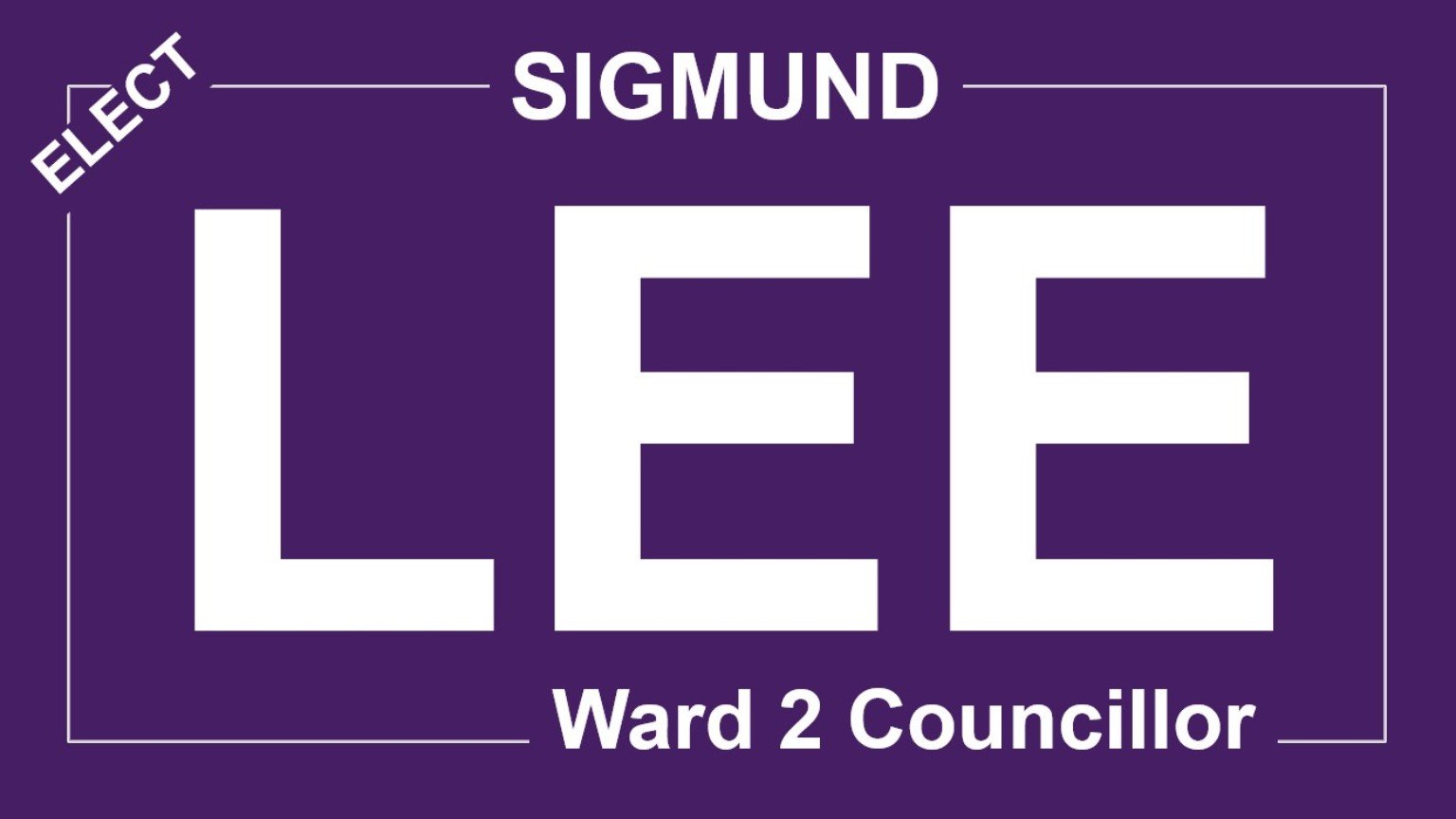
I have received many calls from residents asking when I will deliver a campaign sign for their lawn.
Thank you for your support. I am sorry to disappoint those who were expecting a sign, and I apologize to anyone who had not heard about my decision.
I have chosen not to use conventional lawn signs in this election as part of my protest against the election-sign fees and restrictions imposed by Richmond Hill and York Region.
I already have all my signs from the last election. The easy choice would have been to pay the fees and put them up again. Instead, I chose to take a stand on rules I believe need to change.
I had planned to use removable magnetic vehicle signs as an alternative. When the City advised me that these were not permitted under its interpretation of the sign bylaw, I complied and stopped using them.
I accept that campaigning without signs on lawns and roads may reduce my visibility and could cost me votes. My decision stands.
What This Decision Says About Me
Residents deserve to know how a candidate responds when standing by a principle carries a personal cost.
If elected, I will listen carefully to residents, examine the evidence and stand up for their interests. I will explain my decisions and remain accountable for them.
I will not avoid raising a concern, challenging a proposal or pursuing a needed change simply because doing so might cost me votes at the next election.
My responsibility would be to serve residents, even when doing so is not politically convenient.
That does not mean I will always be right. It means I will explain my reasoning, hear different views and change my position when the evidence warrants it.
I believe election-sign rules should be clear, practical, proportionate and fair to every candidate. I am prepared to accept the consequences of taking that position.
Your Support Still Matters
If you were hoping to put a sign on your lawn, you can still help:
- Share my website so friends and neighbours can review my experience and proposals.
- Tell others why you are supporting me.
- Pass along my campaign information and voting reminder.
- Make your own plan to vote.
My campaign continues through personal conversations, hand-delivered information and a public record of commentary, proposals and Council submissions.
To everyone who called, thank you. Your willingness to show your support means a great deal to me, with or without a sign on your lawn.
I am asking for your vote for Ward 2 Councillor. I would be honoured to earn your support.
Read my experience, priorities and public record at sigmundlee.com.
Sigmund Lee
Candidate for Richmond Hill Council, Ward 2
Your Tax Dollars Deserve Careful Oversight – September 23, 2026
Your property taxes come out of your household budget. You deserve a councillor who takes the decisions behind that bill seriously.
I am a CPA and FCA (Ireland), with more than 30 years of experience in auditing, finance, oversight and corporate restructuring. My work has involved examining financial information, identifying risks and helping organizations make difficult choices.
On Council, I would use that experience to ask:
- Is this spending necessary and properly costed?
- Have we considered a less expensive way to achieve the same result?
- What evidence shows residents are receiving good value?
Responsible spending also means protecting the services residents rely on. That requires examining priorities carefully and explaining the choices honestly.
I cannot promise that costs will never rise. I can commit to scrutinizing proposals, challenging assumptions and asking those questions before voting to spend your money.
I am asking for your vote for Ward 2 Councillor. I would be honoured to earn your support.
Read about my experience, priorities and public record: sigmundlee.com.
Sigmund Lee
Candidate for Richmond Hill Council, Ward 2
A Quiet Pause and a Website Refresh – September 22, 2026
During my pause in public campaign outreach out of respect for those observing Yom Kippur, I spent some quiet time reviewing and reorganizing my website.
Over the past few months, I have added many commentaries, community updates, Council submissions and news articles. The collection had grown, and it was time to make it easier to navigate.
A Complete Introduction in One Place
The refreshed website brings that work together more clearly. The homepage provides a complete introduction: who I am, why I am running, the concerns I have raised and the practical approach I would bring to Council.
If you read only one page, I want it to give you enough information to consider my candidacy.
For anyone who wants more detail, the supporting reports, submissions and published commentary remain available. You can examine the reasoning and decide for yourself.
Understanding the Issues and Asking Better Questions
My financial background and the City’s long-term spending pressures are now more prominent. They are central to why I am running and deserve a clear explanation.
Meaningful oversight starts with understanding the issue. Knowing which questions to ask, which assumptions to test and when an answer needs further examination is essential.
That is where I believe my experience in auditing and finance can make a practical difference on Council.
Residents should be able to see what concerns I have raised, why they matter and what action I would pursue.
Thank You for Reading and Asking Questions
Thank you to everyone who has taken the time to read, ask questions and share concerns. Those conversations help me understand what residents want to know.
To everyone who observed Yom Kippur, I hope your observance was meaningful.
The refreshed website is here: sigmundlee.com.
Sigmund Lee
Candidate for Richmond Hill Council, Ward 2
Now It’s Time to Vote: Make Your Plan for Ward 2 – September 18, 2026
Voting in the 2026 Richmond Hill municipal election is approaching quickly, and I am encouraging every Ward 2 resident to make a plan now.
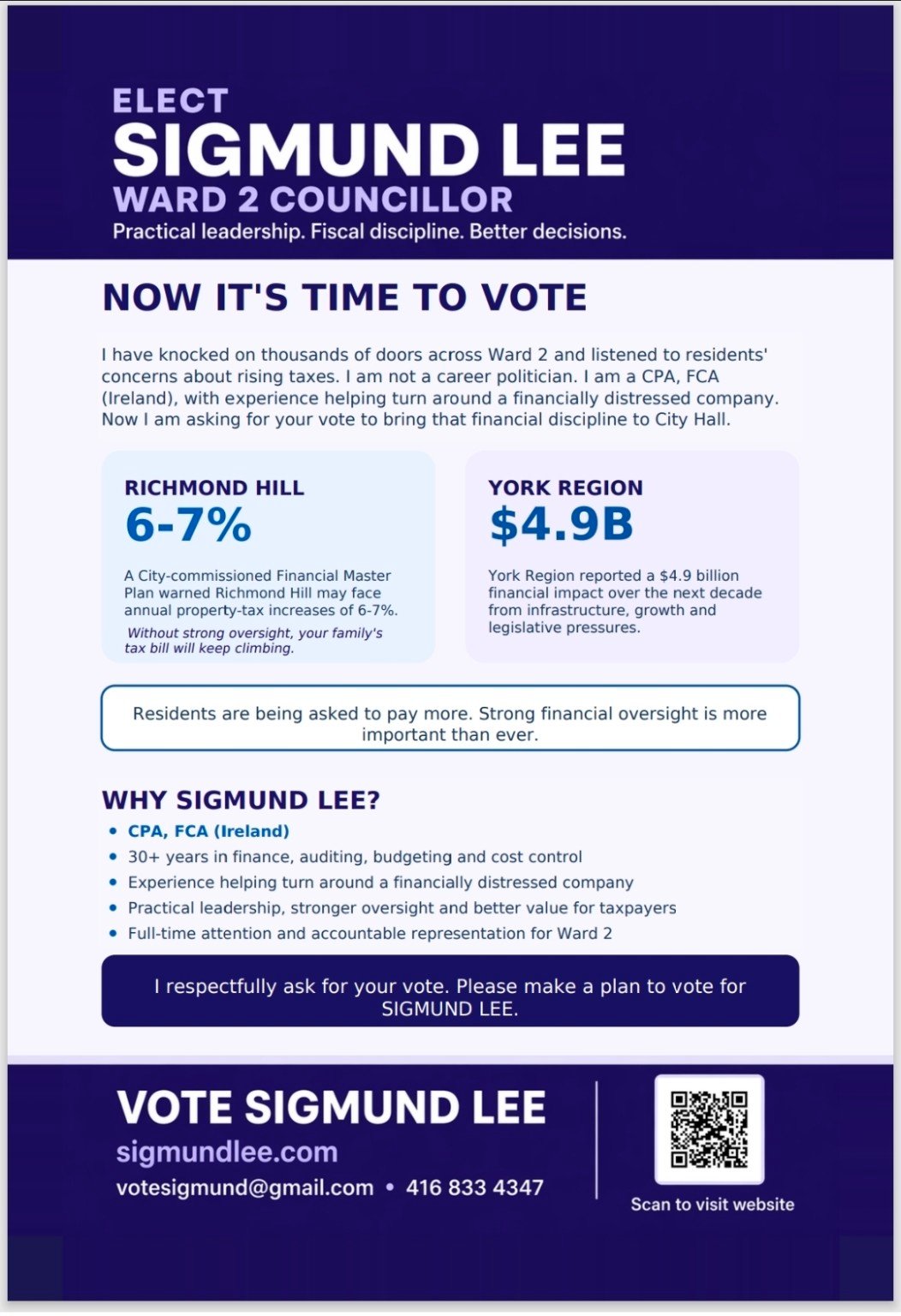
Over the past several months, I have knocked on thousands of doors across Ward 2.
I have listened to residents talk about taxes, traffic, development, City services, safety, communication and whether City Hall is making decisions with enough discipline and accountability.
Now the next step belongs to voters.
At election time, residents have the opportunity to decide whether they are satisfied with the direction of the City or whether they want a different approach.
The decision is now in residents’ hands.
Watch for Your Voting Information
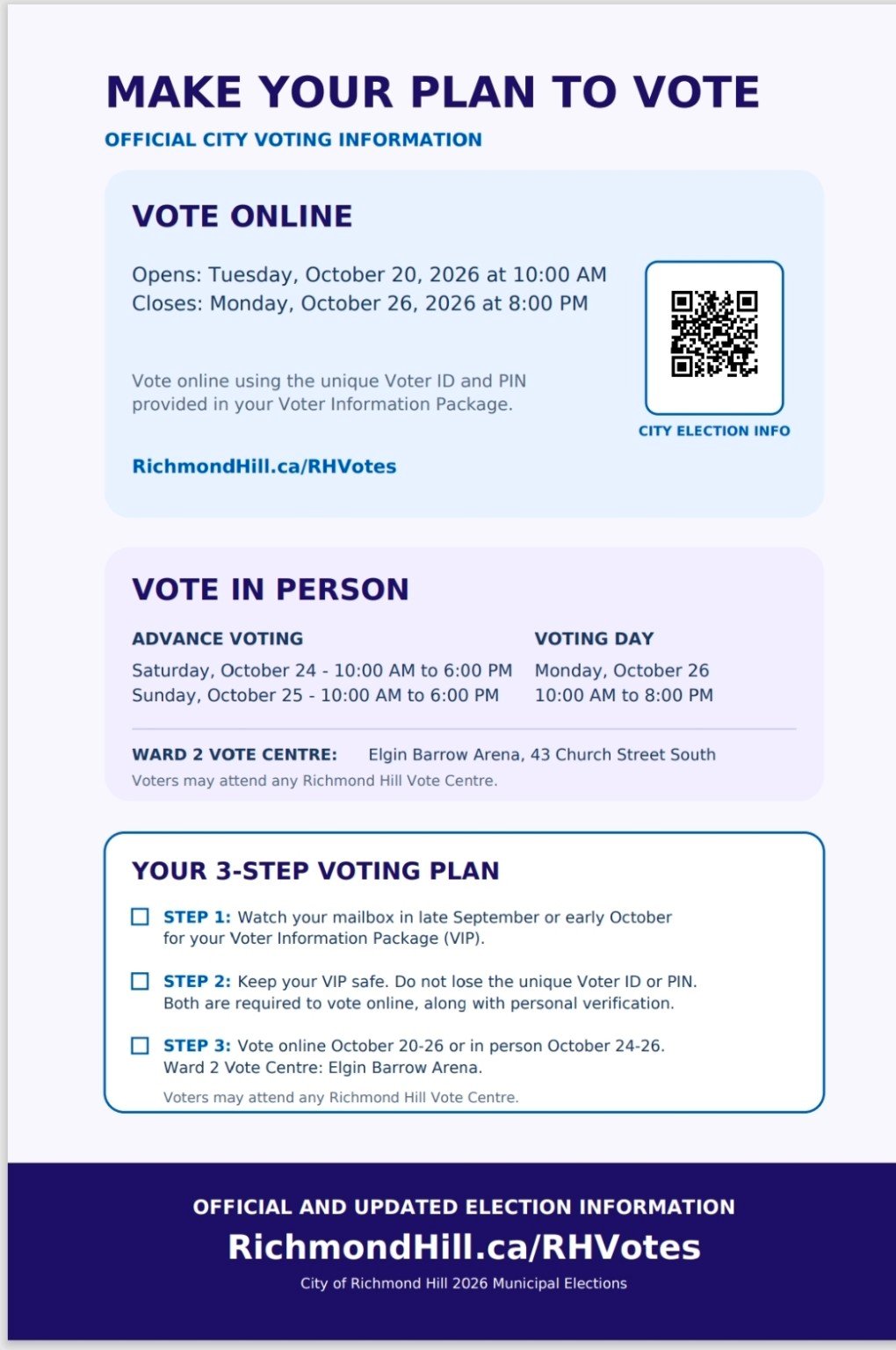
Over the next few weeks, Ward 2 residents may see the voting reminder card shown above at their door.
In some neighbourhoods, I may also be knocking again to remind residents about the election and answer any questions I can.
If I miss you, the message is simple: please watch for your Voter Information Package, keep your Voter ID and PIN safe and make your plan to vote.
Vote Online
Online voting opens on Tuesday, October 20, 2026 at 10:00 AM and closes on Monday, October 26, 2026 at 8:00 PM.
To vote online, you will need the unique Voter ID and PIN provided in your Voter Information Package.
Please keep your Voter Information Package in a safe place when it arrives.
Vote in Person
Residents may also vote in person.
For Ward 2, the vote centre is:
Elgin Barrow Arena
43 Church Street South
Advance voting is available on Saturday, October 24 and Sunday, October 25 from 10:00 AM to 6:00 PM.
Voting Day is Monday, October 26 from 10:00 AM to 8:00 PM.
Residents may attend any Richmond Hill Vote Centre, but Ward 2 residents who want the closest local option can use Elgin Barrow Arena.
This Election Matters
Richmond Hill residents are being asked to pay more.
A City-commissioned Financial Master Plan warned that Richmond Hill may face annual property tax increases of 6 to 7 percent.
York Region has also reported a $4.9 billion financial impact over the next decade from infrastructure, growth and legislative pressures.
Without strong oversight, your family’s tax bill will keep climbing.
I am running because I believe Ward 2 needs practical leadership, fiscal discipline and better decisions at City Hall.
I am a CPA, FCA (Ireland), with more than 30 years of experience in finance, auditing, budgeting and cost control. I am not a career politician.
I believe Council needs to ask better questions, challenge costs earlier, explain decisions clearly and follow through.
Your 3-Step Voting Plan
- Watch for your Voter Information Package.
- Keep your Voter ID and PIN safe.
- Vote online October 20 to 26, or in person October 24 to 26.
I respectfully ask for your vote for Ward 2 Councillor.
Vote Sigmund Lee.
Practical leadership. Fiscal discipline. Better decisions.
Sigmund Lee, CPA, FCA (Ireland)
Candidate for Richmond Hill Council, Ward 2
What Skills Should Residents Expect Around the Council Table? – September 16, 2026
Being approachable matters. Residents should expect their councillor to listen, respond to concerns, attend community events and remain connected to the neighbourhoods they represent.
A councillor should be someone residents feel comfortable contacting.
But approachability is only one part of the job.
Richmond Hill Council governs a complex municipal organization. Councillors approve hundreds of millions of dollars in spending, consider major development applications, establish service levels, oversee infrastructure plans and make decisions whose financial consequences can continue for decades.
That requires more than visibility and good intentions.
The Work Residents Do Not Always See
Residents understandably judge councillors by the work they can see.
They may remember that a councillor attended a community event, responded to an email, helped resolve a local issue or was pleasant to speak with.
Those experiences are important. They help residents determine whether an elected representative is accessible and cares about the community.
However, much of a councillor’s most consequential work is less visible.
It involves reading lengthy staff reports, examining budgets, evaluating forecasts, understanding planning rules, reviewing contracts, considering legal and operational risks and deciding whether the information presented is sufficient to support a vote.
A proposal may sound attractive while its complete cost remains unknown.
A project may be affordable to begin but expensive to operate, maintain and eventually replace.
A short-term solution may create a long-term obligation. A popular decision today may place additional pressure on taxes, user fees or municipal services tomorrow.
That is why residents should consider not only whether they like and trust a candidate, but also what knowledge, judgment and skills that person would bring to the Council table.
What Skills Matter?
No councillor will be an expert in every municipal subject. Council benefits when its members bring different professional experiences, community perspectives and areas of knowledge.
However, every councillor should demonstrate several core abilities.
Financial Literacy
Councillors should be able to understand operating and capital budgets, reserves, debt, forecasts and the long-term cost of decisions.
They should know the difference between the amount required to begin a project and its complete lifecycle cost.
Using reserve money does not make a project free. Borrowing can move a cost into the future, but it does not eliminate it.
Critical Analysis
Councillors should be prepared to ask what information is missing.
What assumptions support the recommendation? What alternatives were considered? What risks remain? What measurable result should residents expect? What happens if the original forecast proves incorrect?
Asking these questions is not obstruction. It is part of responsible oversight.
Independent Judgment
Council decisions should not be based solely on popularity, political convenience or the desire to avoid disagreement.
A councillor must be willing to support a good proposal, question an incomplete one and oppose a decision that is not in the public interest.
Independent judgment sometimes requires asking uncomfortable questions.
Understanding Roles and Responsibilities
Municipal issues often involve Richmond Hill, York Region, the Province of Ontario, the federal government or more than one level of government.
A councillor should understand which government has the authority to act, where coordination is required and when a proposal duplicates work being done elsewhere.
Residents deserve action, not confusion about jurisdiction or motions that create attention without producing results.
Risk Assessment
Every important decision carries financial, legal, operational or community risks.
Council should understand those risks before making a commitment.
What could go wrong? How likely is it? Who will be responsible? What will it cost? Can the decision be reversed if circumstances change?
Good oversight identifies risks early, when there is still an opportunity to reduce them.
Collaboration and Persuasion
One councillor is one vote around the Council table.
Leadership is not about pretending that one person can make every decision. It is about presenting a clear and informed position, helping other members understand the consequences and building support for a better outcome.
A councillor should be able to disagree respectfully while continuing to work constructively with colleagues and staff.
Communication and Follow-Through
Residents should not have to guess why a decision was made.
A councillor should be able to explain the options, costs, risks and reasons for a vote in plain language.
Accountability also continues after approval. Did the project remain within budget? Was it completed as promised? Did it produce the expected benefit? If not, what should change?
What Does an Endorsement Tell Us?
Endorsements are a normal part of elections.
An endorsement may tell us that someone likes a candidate, trusts that person, values assistance they received or respects the candidate’s community involvement.
Those are legitimate considerations.
But an endorsement does not, by itself, demonstrate that a candidate can analyze a municipal budget, evaluate a capital project, understand a planning report or identify a long-term financial risk.
Popularity can tell us whether a candidate is liked. It cannot, on its own, tell us whether that person is prepared to govern.
Residents should consider endorsements, but they should also examine the candidate’s own record, experience, judgment and public work.
- What questions has the candidate asked?
- What issues has the candidate examined?
- Has the candidate demonstrated an ability to understand complicated information?
- Has the candidate offered practical solutions?
- Has the candidate explained how decisions would be made?
Richmond Hill’s Next Council Will Face Difficult Choices
Richmond Hill’s Financial Master Plan forecasts significant financial pressure during the next term and beyond.
Future councils may need to decide which projects proceed, which are phased or delayed, how reserves are protected, when debt is appropriate and how services can remain affordable.
These choices will require more than good intentions.
They will require preparation, financial understanding, independent judgment and the willingness to ask difficult questions before voting.
Being friendly, visible and responsive remains important. Residents deserve those qualities from every elected representative.
But approachability alone is not a qualification for governing a complex city.
A councillor should be approachable enough to listen, skilled enough to understand, independent enough to question and responsible enough to explain the decision.
As a CPA and FCA (Ireland) with more than 30 years of experience in finance, auditing, oversight and corporate restructuring, I understand the importance of examining the complete picture before making a commitment.
I will not pretend to know everything about the City’s internal operations before serving on Council. No responsible candidate should.
What I can bring is the experience to examine financial information, identify risks, ask direct questions, challenge assumptions and follow decisions through to their results.
Residents are not simply choosing the person they would most enjoy meeting at a community event.
They are selecting someone to help govern Richmond Hill.
That decision deserves a careful examination of both character and capability.
Sigmund Lee, CPA, FCA (Ireland)
Candidate for Richmond Hill Council, Ward 2
Today, I Won a Million Dollars While Door Knocking – September 7, 2026
Some door-to-door conversations begin with City issues. Today’s began with fig trees and ended with two plants in my SUV.
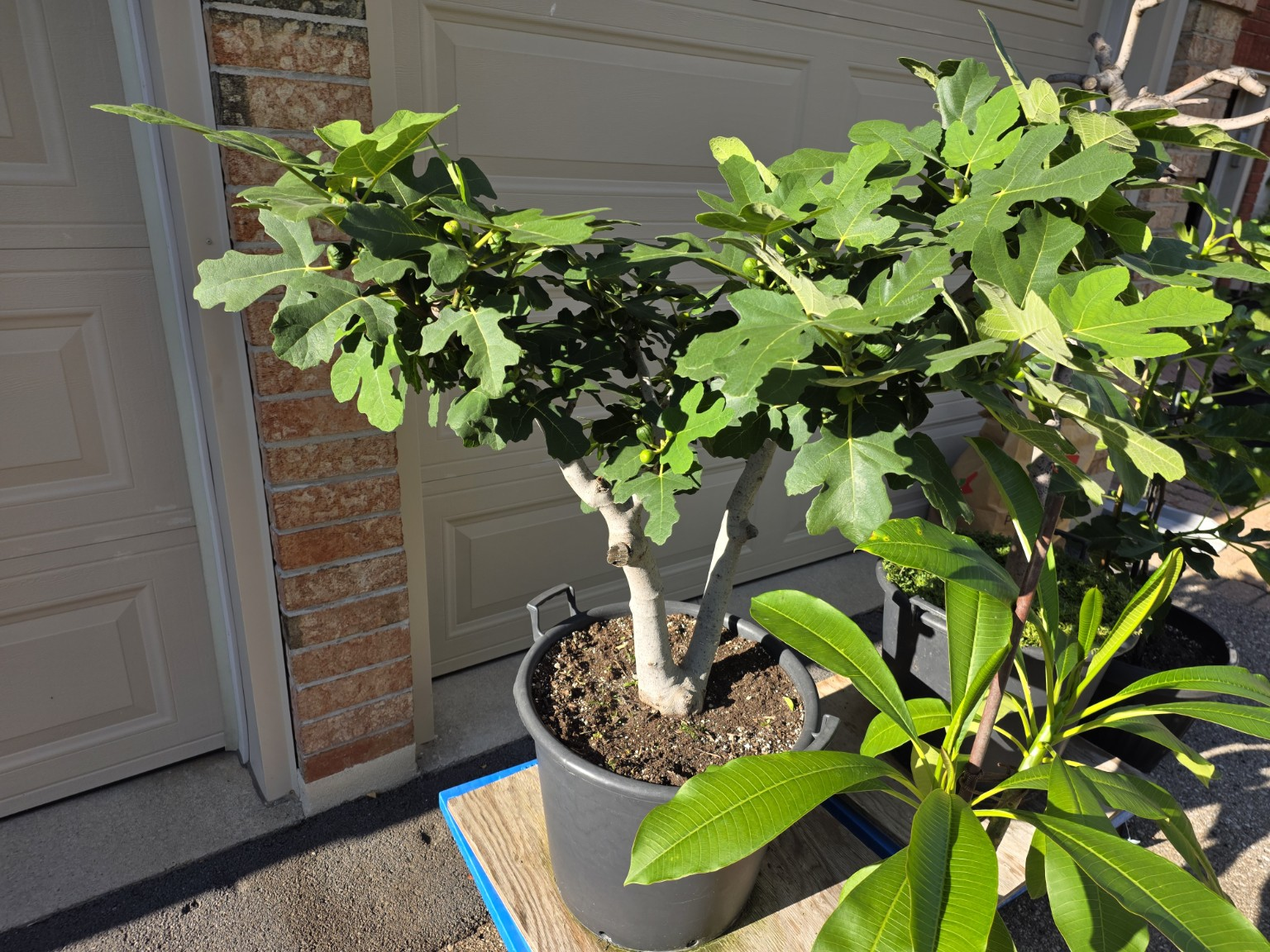
As I walked up a resident’s driveway, something immediately caught my attention. Around the front of his home and garage were more than ten fig plants. They were healthy, full and carrying an extraordinary number of figs. Some appeared to have at least 100 figs on a single plant.
Normally, the first words out of my mouth when I approach a resident are, “Hi, I’m Sigmund.”
Not today.
Instead, I said, “I admire your fig plants. There are so many figs on them!”
A Seven-Year Wait
I explained that seven years ago, I grew a fig plant from seeds taken from fruit I bought at the supermarket. The plant grew, but after seven years, it still has not produced a single fig. Someone also gave me another fig plant earlier this year, but my hope of having a productive fig tree has not yet been fulfilled.
The resident picked a ripe fig from one of his plants and handed it to me to taste.
Wow. It was incredibly sweet.
That one comment about his plants turned into a conversation lasting about an hour and a half. We talked about figs, how to grow them and how he cares for his plants.
Then, completely unexpectedly, he told me that he would give me two fig plants.
One of them already had a single fig growing near the top.
He told me, “Next year, you will get a lot. If you are lucky, you may get more than 100.”
He also said that if I had any problems with the two plants, I should come back and he would give me more. He then helped me load both plants into my SUV.

The Flyers in My Hand
Up to this point, we had not discussed the election at all.
As I was finally getting ready to leave, he noticed that I still had flyers in my hand.
“What are those for?” he asked.
I told him, “I just won a million dollars. Now I am ready to run!”
He laughed and said, “Those fig plants are not worth a million dollars.”
My answer was simple:
“They are to me.”
For seven years, I have wanted a fig plant that would finally produce fruit. Today, a resident shared his knowledge with me, gave me two plants and may have helped make that small dream come true.
Only then did I explain the flyers and tell him that I was running for Richmond Hill Council in Ward 2.
This may be the first time I have spent an hour and a half with a resident before introducing myself as a candidate. LOL.
Campaigning is often measured by the number of doors knocked, flyers delivered and votes received. But a door is not only a number. Behind every door is a person with knowledge, interests, stories and, sometimes, extraordinary generosity.
I walked up his driveway intending to introduce myself. Instead, I enjoyed a wonderful conversation, tasted one of the sweetest figs I have ever eaten, learned how to care for fig plants and came home with two new trees.
That is one door I will never forget. To me, those plants truly are worth a million dollars.
Sigmund Lee
Ward 2 Council Candidate
When Candidates Cannot Reach the Door, Voters Lose Out – September 3, 2026
Door-to-door canvassing gives residents an opportunity to meet the people asking for their vote, raise concerns and ask questions directly.
For residents living in houses, that opportunity is usually straightforward. In apartment buildings, condominiums and other multi-unit residences, however, access can depend on the decision made at the front desk.
During this campaign, I have encountered several buildings where I was told that candidates were not allowed to canvass. This happened even after I showed staff a letter from the Richmond Hill City Clerk explaining the access rights provided under Ontario law.
In some cases, after further discussion, I was eventually permitted to enter only after promising not to knock on residents’ doors. I accepted that restriction because delivering information to each door was still better than leaving everything in a common area. At least residents would have an opportunity to see the material and decide whether they wanted to read it.
At another building, I was asked to leave my campaign materials near the mail area for residents to pick up. I asked how long they would remain there. I was told one or two days, after which anything left would be discarded.
A campaign flyer cannot help someone make an informed decision if that person never sees it. Leaving a stack of flyers temporarily in a common area is not the same as allowing residents to meet a candidate, ask questions or choose whether to accept the information at their own door.
What the City Clerk’s Letter Says
The Canvassing Letter 2026 issued by Richmond Hill’s City Clerk quotes section 88.1 of Ontario’s Municipal Elections Act:
No person who is in control of an apartment building, condominium building, non-profit housing cooperative or gated community may prevent a candidate or his or her representative from campaigning between 9 a.m. and 9 p.m. at the doors to the apartments, units or houses, as the case may be.
The letter also cites the Residential Tenancies Act, the Co-operative Corporations Act and the Condominium Act. These laws protect reasonable access for candidates or their authorized representatives to canvass and distribute election material.
The words “at the doors” matter. A temporary pile of flyers near a mail area is not the same opportunity described in the Clerk’s letter.
Different Buildings Have Different Responsibilities
I also understand that not every residential setting is the same. Long-term care homes must protect residents who may be medically vulnerable. When I am told that canvassing is not permitted because of health or safety concerns and that my materials must be left at reception, I do not argue or plead for entry.
I respect those instructions because protecting long-term care residents must always be the utmost concern.
That is different from an ordinary apartment or condominium building refusing access even after being shown the City Clerk’s letter, or allowing access only after repeated discussion.
Building security is important. Reasonable arrangements such as signing in, providing identification and respecting appropriate hours can protect residents while still allowing candidates to reach them. What is needed is a clear and consistently applied process.
This Is About the Rights of Residents
This issue is not simply about making canvassing easier for candidates. It is about whether residents living in multi-unit buildings receive the same opportunity to participate in an election as residents living in houses.
Some residents, particularly seniors and people with limited mobility, may depend more heavily on candidates coming to them. If candidates are stopped in the lobby, those residents may never have the chance to meet them, ask a question or explain a neighbourhood concern.
Election access should not depend on how long a candidate is prepared to plead at the front desk, which staff member happens to be working that day or whether a resident notices a flyer before it is discarded.
If residents have the right to choose among all candidates, every candidate should have a fair opportunity to reach them.
When candidates cannot reach the door, voters lose out.
Sigmund Lee
Ward 2 Council Candidate
Supporting Seniors Means Recognizing What Works and What Is Still Missing – September 2, 2026
During this campaign, I have met many seniors at their doors and listened to a wide range of experiences.
Some are active, independent and deeply involved in the community. Others face challenges involving mobility, transportation, housing, isolation, affordability or technology.
Seniors are not one uniform group, and supporting them requires more than a single program or campaign promise.
I have also seen the importance of accessible programs firsthand through my volunteer work with the Richmond Hill Computer Technology Volunteers at the McConaghy Centre. We help adults 55+ become more comfortable using computers, smartphones and tablets.
That experience has shown me what Richmond Hill can accomplish when the City provides facilities and community volunteers contribute their time, knowledge and patience. It has also shown me how easily people can be left behind as more information and services move online.
What Richmond Hill Is Doing Well
Richmond Hill has a solid range of recreation and social programs for older adults, including fitness, technology, arts, language programs, outings and drop-in activities.
Programs are offered at five main locations. Residents aged 65 and older also receive a 30% reduction on most recreation registration fees and fitness memberships.
Other positive services and initiatives include:
- Windrow clearing for more than 50,000 local residential driveways.
- A $454 property tax grant in 2026 for qualifying low-income senior homeowners who receive the Guaranteed Income Supplement.
- Programs intended to reduce social isolation and help seniors remain active and connected.
- An Age-Friendly Community Strategy approved by Council in 2023.
- An Age-Friendly Community Council involving older residents, community organizations and businesses that serve seniors.
These are genuine strengths and should be recognized.
However, the existence of programs does not necessarily mean that every senior can find them, reach them, afford them or participate in them.
There is also a capacity problem. When registration opens, spaces in some popular seniors’ programs can be filled within minutes, leaving other residents on waiting lists.
This demand demonstrates the value of the programs, but it also raises important questions. Are enough spaces being offered? Can successful programs be expanded? And are seniors who are less comfortable with online registration being placed at a disadvantage?
A full program is a sign of success, but a long waiting list is also a sign that the community needs more capacity.
Learn more about Richmond Hill’s programs for adults 55+
What Is Still Missing?
Richmond Hill’s own age-friendly consultation identified several areas requiring additional attention:
- More affordable and suitable housing for seniors who want to downsize while remaining in their community.
- Transportation that is affordable, accessible and flexible, particularly for people who no longer drive.
- Safer streets, sidewalks, trails and crossings for people with mobility limitations.
- Easier access to information about programs, financial assistance and community services.
- Better outreach to isolated seniors, newcomers and residents facing language or technology barriers.
- Better coordination and navigation of health and community support services.
- Continued expansion of seniors’ programs as Richmond Hill’s older population grows.
Adopting a strategy is a worthwhile beginning, but a strategy should eventually produce visible and measurable results.
Residents should be able to see which recommendations have been completed, what remains outstanding, what the work is costing and whether it is making a meaningful difference.
Read about Richmond Hill’s Age-Friendly Community Strategy
What Can Richmond Hill Do Better?
Municipal government cannot provide every service seniors require. Healthcare and long-term care, for example, are primarily provincial responsibilities, while public transit is largely operated by York Region.
However, Richmond Hill still has an important role to play.
Make Information Easier to Find
Richmond Hill should produce one clear guide explaining seniors’ programs, recreation discounts, tax assistance, transportation options and community support services.
It should be available online, in print and in commonly used languages. Copies could be distributed through community centres, libraries, seniors’ buildings and local organizations.
Not everyone is comfortable navigating multiple websites or completing an online application.
Report Measurable Progress
The City should publish an annual progress report on its Age-Friendly Community Strategy.
The report should explain what has been completed, what is underway, what has been delayed and what measurable results have been achieved. This would allow residents and Council to determine whether the strategy is being implemented effectively.
Examine Accessibility Where It Matters Most
The City should regularly examine sidewalks, crossings, lighting, benches and snow clearing around seniors’ residences, community centres, medical offices and other frequently used locations.
A sidewalk may technically exist but still be difficult to use with a wheelchair, walker or other mobility aid.
Help Seniors Remain in Their Community
Many seniors want to downsize without leaving Richmond Hill or moving far away from family, friends and familiar services.
Through planning and zoning decisions, the City can encourage a greater variety of accessible housing options near shops, community services and public transportation. This must include housing that seniors with different incomes can realistically afford.
Reach the People Who Are Not Already Participating
The seniors attending recreation programs and community events are the easiest to reach. The greater challenge is identifying and connecting with people who are isolated, unable to travel, facing language barriers or unaware of available support.
The City should work with community organizations, libraries, volunteers and residential buildings to bring information closer to those residents.
Continue Supporting Digital Literacy
Technology can help seniors communicate, access services and remain independent. It can also expose people to online fraud, confusing applications and rapidly changing systems.
Digital services should continue to expand, but reasonable telephone, printed and in-person alternatives should remain available. Digital convenience should not become digital exclusion.
For programs that can be delivered effectively online, Richmond Hill should consider adding Zoom or hybrid sessions. This could expand capacity and help seniors who face mobility, transportation or weather-related barriers.
Online participation should be an additional option, not a replacement for in-person programs. Some seniors require assistance using the technology, while others depend on these programs for face-to-face social contact.
Listening Before Deciding
My volunteer experience at McConaghy and my conversations at the doors have reinforced the importance of listening before deciding what people need.
The City should continue supporting the programs that are working. At the same time, respecting seniors means being willing to ask who is still being left out, what obstacles remain and whether promised improvements are producing results.
A service only helps when seniors know about it, can reach it and can use it.
Sigmund Lee
Ward 2 Council Candidate
Apparently, Someone Is Reading My Website – August 28, 2026
One benefit of sharing ideas early is that residents can see what a candidate believes before election season becomes crowded. It also creates a public record of when those ideas were shared.
Since launching my website on May 11, 2026, I have written regularly about listening carefully, asking direct questions, exercising independent judgment, explaining decisions and following up so residents are not left without answers.
Recently, I noticed a remarkably familiar combination of these ideas appearing elsewhere.
Apparently, someone is reading my website. LOL.
That is all good. Campaigns should be about ideas, and if more candidates now believe councillors should listen, ask questions, explain their decisions and follow up with residents, Richmond Hill may benefit.
Words Are Only the Beginning
Of course, repeating the words is the easy part. The more important questions are:
- When were the difficult questions asked?
- What action followed?
- What results were achieved?
My website has been active since May 11, 2026 and is updated regularly. The archive remains available for anyone interested in seeing how these ideas developed over time.
Residents can read the record and draw their own conclusions.
Sigmund Lee
Ward 2 Council Candidate
Listening Beyond the Door – August 24, 2026
A conversation with a resident reminded me that listening should not depend on someone opening their door at a particular moment.
The resident said that while he was willing to speak with me, many people prefer not to have their doorbell rung. They may have young children sleeping, seniors resting, family members working from home, or may simply not want to be interrupted.
He asked why I do not provide another way for residents to meet or speak with me.
He is right.
Door-to-door conversations help me hear directly from residents across Ward 2. But I understand that a knock at the door is not convenient for everyone, and I do not want anyone to feel disturbed in their own home.
Residents Can Still Reach Out
I have already heard from residents who chose to contact me directly. One caller raised concerns about several short-term rental properties on his street, cars parked on the road, loud music and other neighbourhood issues. We were not able to speak at the door, but he still made the effort to call because he wanted his concerns heard.
That is why it is important to provide another way to connect.
If I leave a flyer at your door and you would like to talk, you can contact me when it suits you. We can arrange a time to meet at your home, at a convenient public place such as Tim Hortons, or speak by phone.
The important thing is that residents have a reasonable opportunity to be heard, without needing to open the door at an inconvenient time.
Sigmund Lee
Ward 2 Council Candidate
Choosing the Right Words – August 19, 2026
Sometimes we know exactly what we mean, but others may reasonably understand our words differently.
A resident recently asked me about this sentence on my website:
“Rather than relying only on mass flyer distribution, much of our communication takes place through direct conversations, community engagement, and regular updates on this website.”
I knew what I meant. I was referring specifically to Canada Post Admail. However, the resident understood the sentence to mean that I was not widely delivering flyers or knocking on doors.
That was certainly not my intended message. I have personally been knocking on doors throughout Ward 2, speaking directly with residents and delivering my campaign information.
Clarity Requires Listening
This was a useful reminder that good communication is not only about what we intend to say. It is also about how others may reasonably understand our words.
When wording is unclear, the right response is to listen, clarify it and improve it. This applies to a campaign website, everyday conversations and communication from City Hall.
Sometimes one honest question can improve a message more than ten compliments.
Sigmund Lee
Ward 2 Council Candidate
Principle Before Political Convenience – August 17, 2026
Politics often encourages people to ask one question: Will this help me win?
I believe there is a more important question: Is it right?
There have been times when I have defended someone’s right to participate in our democratic process, even when doing so may not have been politically helpful to me.
That did not mean I agreed with everything that person had said or done. It meant I believed the final decision belonged to the voters.
The Right to Participate
Every eligible candidate has the right to run for public office. No candidate owns a ward, and no one should be discouraged from participating simply because their candidacy may affect someone else’s chances of winning.
Democracy cannot mean that people have the right to run only when their participation helps our preferred outcome.
Principles Can Have a Cost
The same principle should guide decisions at City Hall. It is easy to support what is popular, convenient or politically beneficial. Leadership is tested when doing what is fair may come with a political cost.
I will not pretend that principle is always rewarded. Sometimes it may cost support. Sometimes people you defended may not show you the same consideration in return.
That does not make the original decision wrong.
Do I Really Want to Win?
Yesterday, I was asked an important question: “Do you really want to win?”
My answer was simple: “If I win, I lose. If I lose, I win.”
If I am elected, I gain the privilege of serving Ward 2 and the opportunity to make a difference at City Hall. At the same time, my income would be reduced by a large chunk, and I would take on significant additional responsibility. That is a sacrifice I am prepared to make.
If I am not elected, I keep my career, my income and more of my personal time. I will also continue contributing to my community in other ways, as I have always done.
I want to win, but I do not need to win at any cost. I will campaign according to my principles, present my experience and ideas honestly, and let the voters decide.
Winning an election matters, but it should never matter more than the values we claim to represent. If we abandon those values whenever they become inconvenient, then they were never really principles in the first place.
For me, principle must come before political convenience.
Sigmund Lee
Ward 2 Council Candidate
Campaign Break: Joke of the Day – August 17, 2026
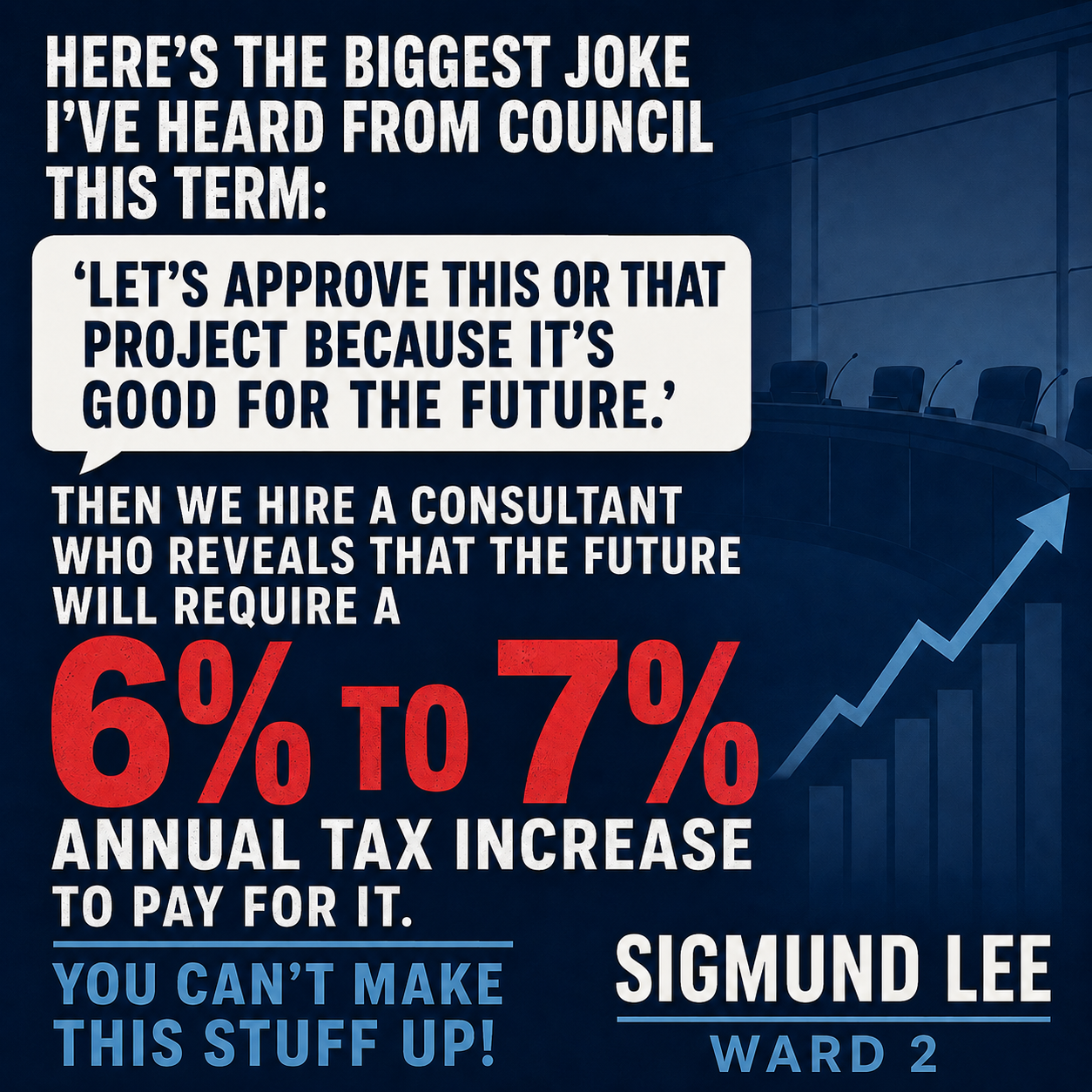
A little budget humour during a brief break from the campaign.
Here is the biggest joke I have heard from Council this term. Unfortunately, the numbers behind the joke are very real.
Sigmund Lee
Ward 2 Council Candidate
You May Recognize This Sign – August 17, 2026
Some Ward 2 residents may recognize the purple campaign sign in this picture.
These are signs from my 2022 municipal election campaign. I kept them carefully, and because they are still in good condition, I will be using them again in this election.
I also kept the magnetic campaign signs for my car. They are ready to go back on the road.
Why Replace Something That Still Works?
Reusing these signs saves money and reduces waste. It also reflects something I strongly believe in. Fiscal responsibility is not just something we should expect from City Hall. It should also guide the decisions we make ourselves.
During this campaign, I have knocked on thousands of doors across Ward 2. Many residents recognize my name, my face or the purple sign from the last election. Sometimes that recognition is the reason someone opens the door and gives me the opportunity to listen and speak with them.
That recognition was earned through the work I did in 2022 and through my continued involvement in our community.
This campaign is not about starting over. It is about building on the relationships, experience and trust developed over the years.
The signs may be from 2022, but my commitment to Ward 2 is stronger than ever.
The name is still the same. The ward is still the same. The commitment continues.
Would You Like a Lawn Sign?
If you would like to show your support with a Sigmund Lee lawn sign, you can submit your request early. Signs will be delivered after September 26.
Email votesigmund@gmail.com with your name, address and contact information to request a sign.
Thank you for your support.
What Kind of Councillor Will I Be? – August 14, 2026
A resident recently asked me one of the most direct and important questions I have heard while door-knocking: what kind of councillor would I be after the election?
The question had three parts:
- Would I be seen only during an election, asking residents for their votes?
- Would I become a photo-op councillor, appearing mainly at ceremonies and public events?
- Or would I remain visible in Ward 2, attending to neighbourhood issues and residents’ concerns throughout the full term?
The third describes the standard I would set for myself.
Visible in the Ward
I want to be a councillor residents see in Ward 2, not only at public events, but regularly in their neighbourhoods.
If elected, my goal is to personally conduct two or three ward-wide door-knocking rounds during the four-year term. These visits would not be election canvassing. They would be opportunities to ask residents what is happening in their neighbourhoods, hear their concerns directly and remain connected to the people I represent.
I know I will not find everyone at home. Where no one answers, and where there is no notice asking that materials not be left, I would leave a brief ward update and my official contact information so residents know how to reach me.
This is a concrete goal I would set for myself, one residents could judge me against. Contact with residents should continue between elections, not begin again when it is time to ask for another vote.
When appropriate, being visible also means visiting the location of a traffic, road, property or development concern so I can better understand what residents are experiencing. It means speaking with the people affected, asking questions and seeking reliable information before reaching a conclusion.
Being visible does not mean inserting myself into every active incident. During an emergency or police operation, for example, elected officials should not interfere with the professionals doing their jobs. In those circumstances, serving residents may mean helping them find accurate information, asking appropriate questions afterward and following up when the immediate situation has concluded.
Public ceremonies and community events are part of a councillor’s role, but visibility should extend beyond those occasions. Being present should be about helping residents and not simply being present for a photograph.
Social media is useful for sharing information and keeping residents informed. However, online visibility is not the same as community presence. Sharing information from the City or other organizations can be helpful, but it should support and not replace direct conversations with residents, attention to neighbourhood concerns and follow-through on the issues they raise.
Listening Does Not Always Mean Agreeing
Some residents have told me they want a councillor who will stand up for them. I agree, but I also believe it is important to explain honestly what that means.
Residents will not always agree with one another. A request from one group may affect another neighbourhood, conflict with an existing policy or create costs that all taxpayers must carry. A councillor must consider the law, available evidence, financial consequences and the interests of the wider community.
I will stand up for residents by ensuring their concerns are heard, properly examined and answered. That does not mean promising that every request will be approved. It means residents will not be ignored.
If I cannot support a request, residents deserve an honest explanation. Representation should not mean saying yes to everything during an election and explaining the limitations afterward.
Turning a Concern into Council Action
Richmond Hill Council consists of the Mayor and eight other members. A Ward 2 councillor would therefore be one voice and one vote on a nine-member Council.
No individual councillor can honestly guarantee that every proposal will pass. On a full Council, forming a majority normally requires at least five votes.
To me, fighting for residents does not mean being the loudest person in the room. It means doing the work required to turn a concern into possible action: gathering the facts, presenting a persuasive case, addressing costs and objections, proposing a motion or amendment when appropriate, and trying to convince enough Council colleagues to support it.
I may not always succeed in building that majority. However, residents should know that a genuine effort was made, how I voted and what Council ultimately decided.
Oversight at the Council Table
Being visible in the ward is only one part of the job. Residents also deserve a councillor who reads the reports, scrutinizes budgets and expenditures, and asks difficult questions before casting a vote.
A proposal may sound worthwhile, but Council must still understand its full cost, how it will be funded, what other priorities may be affected and whether it will create continuing expenses for taxpayers. Asking those questions is not opposition for its own sake; it is responsible oversight.
Transparency means giving residents clear information about how and why decisions are made, including the costs and trade-offs. Public money and City resources must be used carefully and for legitimate public purposes and not for personal or political advantage.
I will not agree with every recommendation simply because it appears in a staff report or has support around the Council table. I will review the information, ask questions, exercise independent judgment and explain my vote.
Following an Issue Through
Forwarding a resident’s email should not automatically be the end of a councillor’s involvement. Residents should receive an acknowledgement, know who is responsible for the issue and be kept informed when an answer takes time.
Some concerns fall under the City, while others are the responsibility of York Region, the Province, police, utilities or another organization. A councillor may not control those agencies, but can still help identify the responsible body, seek information and direct residents toward the appropriate process.
Follow-through also means closing the loop. Even when the final answer is not what a resident hoped to receive, they should not be left wondering whether anyone looked into the matter.
The Standard I Would Set
Residents do not need a councillor who agrees with everything. They need someone who shows up, listens, investigates, exercises judgment, works to build support and explains what happens next.
I cannot predict every issue that may arise during a four-year term. What I can offer is an approach: remain connected to the ward, take residents seriously, ask questions, consider the consequences and communicate honestly.
I do not want residents to see me only when I am asking for their votes. I want them to know that their councillor remains present after the election is over and that their concerns will receive attention, even when the answer is complicated.
What qualities do you expect from your Ward 2 councillor? I’d like to hear from you. Please share your thoughts through my contact page.
When Most Residents Don’t Vote, Who Makes the Decision? – August 5, 2026
Municipal government may not receive the same attention as federal or provincial politics, but its decisions often affect our daily lives most directly.
Property taxes, roads, snow clearing, garbage collection, parks, recreation programs, water services, local development and many other community services are shaped by decisions made at the municipal level.
Despite this, most eligible Richmond Hill voters have historically chosen not to participate in municipal elections.
A Continuing Pattern
Richmond Hill’s recent municipal election history shows the continuing challenge of voter participation:
- 2014: approximately 32% voter turnout
- 2018: 27.13% voter turnout
- 2022: 31.67% voter turnout
Although turnout improved in 2022, fewer than one in three eligible voters cast a ballot. This means a relatively small portion of the electorate determined who would represent the entire community for the following four years.
In some individual ward races, the successful candidate may receive only a portion of the votes cast. When that is considered alongside low overall turnout, the number of residents who ultimately determine the outcome can be surprisingly small.
That is not a criticism of the people who vote. They are exercising an important democratic right. The concern is that too many others are allowing that smaller group to make the decision for them.
Voting Is More Accessible
Richmond Hill introduced online voting for the 2022 municipal election, and approximately 83% of the ballots were cast online. Residents could vote securely from home without travelling to a voting location or waiting in line.
For the 2026 municipal election, online voting will be available from 10 a.m. on October 20 until 8 p.m. on October 26. In-person voting with paper ballots will also remain available for residents who prefer it.
With online voting available over several days, residents do not have to leave home to participate. While there may always be reasons people feel disconnected from politics, inconvenience should no longer be a major obstacle.
Participation Begins With Information
A candidate may not always have the opportunity to speak with you personally at your door. If a candidate leaves campaign information, please take a few minutes to read it, visit the candidate’s website and learn more about the person seeking to represent you.
Voting should not mean supporting someone simply because that person knocked on your door, has the most signs or asked for your vote.
Residents should learn about the candidates, review their experience and ideas, ask questions and make their own informed decision. A candidate should earn a vote and not merely request one.
You do not have to agree with every position a candidate takes. The important thing is to determine who you believe has the judgment, commitment and ability to represent the community responsibly.
Municipal elections directly affect our neighbourhoods, our services and how our tax dollars are spent. When most eligible voters remain on the sidelines, they give a small minority the power to choose on everyone’s behalf.
In October, please take some time to learn about the candidates and cast your ballot. Regardless of whom you support, the decision should include your voice.
Sigmund Lee
Ward 2 Council Candidate
What Does a “No Soliciting” Sign Mean During an Election Campaign? – July 28, 2026
While canvassing Ward 2, I occasionally encounter homes displaying “No Soliciting” signs. This raises a reasonable question: does that sign also apply to a political candidate?
A “No Soliciting” sign is generally understood as a request not to receive unsolicited commercial sales calls. Political canvassing is different: a candidate is not selling a product or asking a resident to enter into a commercial contract.
Ontario law also recognizes the importance of political canvassing. Section 88.1 of the Municipal Elections Act provides candidates and their representatives with access to apartment buildings, condominiums, non-profit housing co-operatives and gated communities for campaigning between 9 a.m. and 9 p.m.
For an ordinary house, Ontario’s Trespass to Property Act generally presumes that a person may use the normal walkway to approach the front door for a lawful purpose unless access has been clearly prohibited.
However, this does not give political candidates an unlimited right to disregard a resident’s wishes.
A “No Soliciting” sign may have been posted to discourage salespeople rather than political candidates. A sign stating “No Canvassing,” “Do Not Knock” or “No Trespassing” communicates a broader and clearer request.
Election material is not necessarily considered commercial advertising or “junk mail.” Canada Post states that, even when a household opts out of unaddressed advertising mail, it is still required to deliver certain election materials from election officials, political parties and candidates during an election. However, that rule applies to material delivered through Canada Post. It does not give a candidate personally delivering campaign literature the right to disregard a resident’s clear “No Flyers” or “No Junk Mail” sign. In those circumstances, I respect the resident’s request and do not leave campaign material.
When I see a clear “No Flyers” or “No Junk Mail” sign before leaving campaign material, I respect it and continue to the next house. Occasionally, such a sign may be placed on a mailbox away from the front door and only become visible after I have already left the flyer and begun walking away. In that situation, I generally do not return toward the home to retrieve it, as doing so may cause more disturbance. Any material left in those circumstances is an honest oversight, not an intentional disregard of the resident’s wishes.
If a home displays “No Soliciting,” I do not knock. Most of the time, I simply continue to the next house. Occasionally, if it is a home I specifically intended to visit and the “No Soliciting” sign only becomes visible after I have climbed five steps to the front door, I may quietly leave my campaign information without knocking. Whether the five steps influenced that decision, I will leave for others to decide.
Regardless of the wording, if a resident says they do not wish to speak or asks someone to leave, that request should be respected immediately.
My approach is simple: be courteous, identify myself, keep the conversation brief unless the resident wishes to continue, and never pressure anyone to engage.
Even if we do not have an opportunity to speak personally at the door, I hope the campaign information I leave will help you get to know me, understand what I stand for and decide whether I have earned your support. I also invite you to visit my website or contact me directly with your questions, concerns or ideas for Richmond Hill.
Door-to-door canvassing remains one of the best ways for candidates to hear directly from residents. However, earning the opportunity to represent a neighbourhood begins with respecting the people who live there.
Political canvassing is legally different from commercial solicitation, but respect for a resident’s clearly expressed wishes comes first.
Ontario Municipal Elections Act, 1996 – Section 88.1
Ontario Trespass to Property Act
Elections Ontario – Access for Canvassers
Canada Post: How to Stop Receiving Advertising Mail
Sigmund Lee
Ward 2 Council Candidate
Protecting Our Neighbourhoods Through Fair Property Standards – July 28, 2026
A resident recently spoke with me about garbage, discarded materials and poorly maintained properties in one of Richmond Hill’s older neighbourhoods.
Property standards are not simply about appearance. Accumulated garbage, abandoned materials, unsafe conditions and persistent neglect can affect public safety, quality of life and the value of neighbouring homes.
At the same time, enforcement must be reasonable and fair. A temporarily untidy yard is not the same as prolonged neglect, and some residents may be dealing with age, illness, disability or financial hardship.
Our older neighbourhoods deserve the same level of attention, maintenance and municipal service as newer developments. Older should never mean forgotten.
I have added a new public commentary discussing fair property standards, assistance for residents facing genuine difficulties, and consistent enforcement against serious or repeated violations.
Read the full commentary:
Protecting Our Neighbourhoods Through Fair Property Standards
Sigmund Lee
Ward 2 Council Candidate
Campaign Break: A Public Service Announcement – July 23, 2026
A brief break from campaign topics for an important public service announcement.
Canada’s blood supply has declined by nearly 20% since June 1, far more than the usual decrease experienced during the summer months.
Canadian Blood Services is asking eligible donors of all blood types to book an appointment as soon as possible. Blood is needed every day for surgeries, cancer treatments, emergencies, trauma care, and other essential hospital services.
If you are eligible to donate, please consider making an appointment. A little time out of your day could make a lifesaving difference for someone else.
Learn more or book an appointment:
Canadian Blood Services
Sigmund Lee
Ward 2 Council Candidate
What I Keep Hearing at the Door – July 10, 2026
After knocking on thousands of doors across Ward 2, one comment comes up again and again.
“Politicians only come to my door when they want my vote. Once they’re elected, you never see them again… until the next election.”
I’ve heard this from residents of all ages and from every part of our community. Whether they’re concerned about traffic, speeding, development, parks, or simply feeling disconnected from City Hall, many people tell me they want their elected representatives to be visible and engaged throughout the entire term, not just during election season.
That is one of the reasons I began campaigning early. My goal has never been simply to ask for votes. It has been to listen, learn, and understand the concerns that matter most to Ward 2 residents.
Every conversation is different. Sometimes we discuss local issues. Sometimes residents share ideas for improving our neighbourhoods. Occasionally they simply want someone to listen. Those conversations have been invaluable, and they continue to shape my understanding of what residents expect from their local government.
I believe public service should not begin a few weeks before an election and end the day after. Residents deserve a councillor who is accessible, accountable, and engaged throughout the entire four-year term.
Thank you to everyone who has taken a few minutes to speak with me at your door. Your feedback, encouragement, and ideas are greatly appreciated.
Sigmund Lee
Ward 2 Council Candidate
Campaigning on Canada Day – July 1, 2026
Canada Day is a time to celebrate the country we call home, but it is also a reminder that strong communities are built by neighbours who care and get involved.
I spent part of Canada Day out in Ward 2, meeting residents, delivering campaign literature, and listening to the issues that matter most to our community.
Every conversation is different, but many residents share the same hope: keeping Richmond Hill a great place to live while making sure City Hall remains accountable, practical, and focused on residents.
I am grateful for the friendly smiles, conversations, and words of encouragement throughout the day.
As we celebrate Canada’s history, diversity, and freedoms, let us also look ahead to the future we want to build together, one with responsible leadership, safe neighbourhoods, fiscal discipline, and a strong sense of community.
Happy Canada Day to everyone. Have a safe and enjoyable holiday!
Sigmund Lee
Ward 2 Council Candidate
A Humorous Take on Politics
After spending time knocking on doors and speaking with residents across Ward 2, I recently came across a classic comedy routine by George Carlin called In Defense of Politicians.
While it is comedy, one point stood out to me.
Carlin reminds us that politicians do not appear out of nowhere. They come from the same communities they serve. Whether people agree with his conclusion or not, it is a reminder that democracy is a shared responsibility between elected officials and the citizens who elect them.
As a candidate, I believe residents deserve accountability, transparency, and responsible decision-making from their elected representatives. At the same time, strong communities are built when residents stay informed, ask questions, participate in local government and take the time to learn about the choices before them.
You do not have to agree with everything in the video, but it certainly provides an interesting perspective and a few laughs along the way.
Viewer Discretion Advised: This video contains strong language and mature themes that may not be suitable for children or viewers under 18 years of age. Viewer discretion is advised.
The Early Bird and a Good Laugh
Campaigning often involves serious discussions about taxes, traffic, development, and community safety. But every now and then, a resident says something that makes the whole day memorable.
One of the funnier moments happened while I was door-knocking recently.
A resident asked me why I was campaigning so early.
I smiled and replied:
“Well, the early bird catches the worm. Maybe I can win you over now.”
Without missing a beat, she replied:
“Too late, I’m already married!”
Needless to say, we both had a good laugh.
There is also a serious reason for beginning early. I want residents to have time to visit my website, consider my positions and decide for themselves whether I have earned their support – before campaign flyers from every candidate begin arriving at the same time.
Door-knocking can be challenging. There are plenty of steps to climb, long walks between homes, and many unanswered doors. But conversations like these make the experience enjoyable and remind me why meeting residents in person is so important.
I want to thank everyone who has taken the time to chat, share ideas, offer advice, ask questions, and occasionally keep me laughing along the way.
Ward 2 residents have been welcoming, thoughtful, and full of good humour. Every conversation helps me better understand the community and the issues that matter most to residents.
Have you had a funny or memorable experience with a campaign door-knocker? Or is there an issue you would like me to explore in a future post? I’d like to hear from you – share your thoughts through my contact page.
And yes, I’ll still be trying to catch that worm. 😊
I Only Opened the Door Because I Recognized You
During recent door knocking, a few residents told me something that stayed with me:
“I only opened the door because I recognized you.”
It made me reflect on how much both campaigning and society have changed.
Many people today are understandably cautious about opening their doors to strangers. Concerns about scams, safety, and security are real. More people screen calls, ignore unknown visitors, and avoid unsolicited contact altogether.
That reality creates a significant advantage for incumbents and well-known candidates. Recognition and familiarity often matter before a conversation even begins.
For challengers, the first hurdle is often not persuasion. It is simply getting the opportunity to be heard.
This experience also reinforced the importance of visibility during municipal elections. Residents cannot evaluate candidates they never encounter. Whether through community events, local engagement, campaign signs, or conversations at the door, visibility plays an important role in helping voters become aware of their choices.
At the same time, I am grateful to every resident who has taken the time to speak with me, share concerns, and engage respectfully about the future of Richmond Hill.
These conversations matter.
Ward 2 deserves to be heard.
Related: For additional background on why visibility matters in municipal elections, you can read my commentary on election sign visibility and its impact on challengers.
Read my published letter to the editor on election sign rules
Out in Ward 2 Speaking With Residents
Over the coming weeks, I will be out across Ward 2 meeting residents door-to-door, listening to concerns, and delivering campaign flyers.
I believe the best conversations happen face-to-face. Hearing directly from residents helps me better understand the priorities and concerns within our neighbourhoods.
Many residents have already shared concerns about affordability, property taxes, responsible spending, traffic, community services, and accountability at City Hall.
If you see me in the community, please feel free to say hello, share your concerns, or ask questions. I would be pleased to hear from you.
Thank you to everyone who has already offered encouragement, feedback, and support. I truly appreciate it.
Email: votesigmund@gmail.com
Officially Registered as a Candidate for Ward 2 (May 11, 2026)
Today, I officially registered as a candidate for Richmond Hill Council in Ward 2.
Over the past several months, I have spoken with many residents across our community. Seniors, families, and longtime homeowners have shared a common concern: they expected more from City Hall.
They expected stronger accountability. Responsible spending. Better representation. And clearer value for the taxes they pay.
A recent consultant report warned that Richmond Hill may face property tax increases of 6 to 7 percent annually.
That should concern every resident.
When families face financial pressure, they review spending, tighten budgets, and focus on essentials. City Hall should be expected to apply the same discipline. Residents should not be asked to fund everything that is desirable if it is no longer affordable.
We need to ask the right questions, focus on what is essential, and make sure residents receive clear value for what they pay.
I am running to bring stronger accountability, responsible spending, and practical representation to Ward 2.
You can learn more about my background, priorities, and positions on local issues at:
I would be pleased to hear from you.
Email: votesigmund@gmail.com
Keep Following the Campaign
New updates will be added as I continue meeting residents, listening to concerns and sharing what I learn across Ward 2.
If you would like to receive updates directly, ask a question, or share something happening in your neighbourhood, please contact me.